.png)
Brass or Stainless Steel 316? How to Choose the Right Fitting Material
Updated: Aug 26
Brass costs a fraction of stainless steel, machines faster, and will not seize on its own threads. For a great many systems it is the correct choice, and specifying 316 instead is money spent on nothing. But there are media and conditions where brass fails quickly and predictably, and in those the price difference is irrelevant.
This is a practical guide to which side of that line your application falls on.
The short answer
Choose brass for compressed air, hydraulic oil, lubricating oil, LPG, fuel, and general water service at moderate pressure and near-ambient temperature. It is the standard material for pneumatic lines and instrument air.
Choose SS 316 for chlorides and marine environments, chemical process media, steam, high-pressure instrumentation, high or cyclic temperature, anything ammonia-based, and any system where the fitting must be traceable to a material certificate.
Choose SS 304 where you want stainless properties in a mild environment and no chlorides are present — it costs less than 316 but lacks the molybdenum that resists pitting.
Everything below is the reasoning behind those three lines.
What the materials actually are
Free-cutting brass, CW617N (also called CZ122, CuZn40Pb2). Roughly 57–59% copper, about 2% lead for machinability, the balance zinc. This is the standard alloy for hot-stamped and machined brass fittings worldwide. The lead is what lets it be cut fast and cleanly at low tool cost, and it is also what brings it into scope of drinking-water regulations in several markets.
Dezincification-resistant brass, CW602N (CuZn36Pb2As). Around 62% copper, 35.5% zinc, 2% lead, and critically 0.02–0.15% arsenic, which inhibits the selective leaching of zinc. It is noticeably harder to machine — commonly quoted at somewhere between two-thirds and three-quarters of the machinability of standard leaded brass — and it costs more. It is specified where the part is wetted by potable or aggressive water.
Stainless steel 316 / 316L. An austenitic stainless with 16–18% chromium, 10–14% nickel and, distinguishing it from 304, 2–3% molybdenum. The molybdenum is what buys resistance to chloride pitting. The L grade has carbon held low to avoid carbide precipitation at grain boundaries during welding, which is why weld fittings and welded assemblies are normally specified in 316L.
Corrosion: where each material actually fails
This is the section that decides most specifications.
Brass fails by dezincification
In soft, chlorinated, warm or stagnant water, zinc leaches selectively out of the alloy and leaves behind a porous copper skeleton. The fitting keeps its shape and looks intact from outside, then splits under pressure or blocks the bore with corrosion product. It is a slow failure that gives little warning, and it accelerates with temperature and with water that is low in hardness.
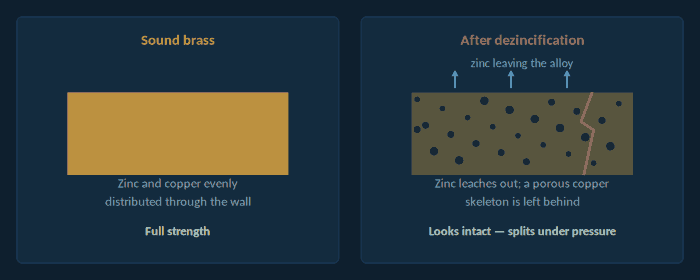
Dezincification: zinc leaches out of the alloy and leaves a porous, pink copper skeleton. The part keeps its shape but loses its strength.
If your water conditions are aggressive, or if you are supplying a market whose plumbing regulations call for it, specify DZR brass rather than standard CW617N. If you are unsure, this is worth asking about at the enquiry stage rather than after installation.
Brass fails fast in ammonia
Ammonia and ammonia-bearing compounds, including amines, cause stress corrosion cracking in copper alloys. The mechanism has been understood for over a century — it was called "season cracking" when it was first observed in brass cartridge cases stored in stables. A stressed brass fitting in an ammonia atmosphere can crack in service in a short time.
There is no version of this that is acceptable. If ammonia is present in the medium or the surrounding environment, brass is out and stainless steel is in. This applies to industrial refrigeration, fertiliser plants, and anywhere amine-based water treatment chemistry is in use.
316 fails by chloride attack, in two ways
Stainless steel does not rust because a thin chromium oxide film re-forms wherever the surface is damaged. Chlorides break that film down locally, and the result is pitting — deep, narrow penetration in an otherwise clean-looking surface. The molybdenum in 316 raises the chloride threshold substantially compared with 304, which is exactly why 316 is the default in coastal and marine work.
The second mode is chloride stress corrosion cracking. Austenitic stainless under tensile stress, in the presence of chlorides, above roughly 50–60°C, can crack transgranularly. Below that band it is rarely a practical concern in immersed service; above it, in chloride service, the risk is real and duplex or higher alloys may be indicated. The exact threshold depends on chloride concentration, stress level and oxygen, so treat 50–60°C as a point at which to start asking rather than a hard line.
External surfaces are a separate case, and a more insidious one. Where chloride concentrates by evaporation — coastal atmospheres, lines under insulation, indoor swimming-pool environments — cracking has been recorded at ambient temperature. The 50–60°C guideline does not protect you there.
316 is also poorly suited to strong reducing acids such as hydrochloric acid at any meaningful concentration.
A summary by medium
Medium | Brass | SS 316 |
Compressed air, instrument air | Suitable | Suitable, usually unnecessary |
Hydraulic and lubricating oil | Suitable | Suitable |
LPG, natural gas, fuel | Suitable | Suitable |
Potable water | DZR brass; check market lead limits | Suitable |
Soft or heavily chlorinated water | DZR brass only | Suitable |
Seawater, coastal atmosphere | Not suitable | Suitable |
Ammonia, amines | Not suitable | Suitable |
Steam | Not suitable above low pressure | Suitable |
General process chemicals | Case by case | Usually suitable |
Hydrochloric or other reducing acids | Not suitable | Not suitable |
Temperature
Brass loses strength as it warms, and any pressure rating quoted at ambient must be de-rated well before 100°C — a fitting rated 300 psi at room temperature may be down to 150–200 psi by 90°C.
Be careful with the alloy limit here, because it is not the product limit. The alloy itself retains useful strength to around 200°C, but many commercial brass compression fittings are rated no higher than about 120–150°C. Read the temperature rating on the specific product rather than assuming the alloy figure. And note that the corrosion mechanisms described above all accelerate long before either limit — in water service, elevated temperature is one of the main accelerants of dezincification.
316 keeps useful mechanical properties far beyond anything a brass fitting will survive. In practice the limiting factor on a stainless fitting assembly is rarely the metal — it is any elastomer in the joint, an O-ring or a bonded seal washer, whose rating will govern. Check the seal specification, not just the fitting.
At the cold end, both materials are serviceable well below zero. Neither austenitic stainless nor brass has a ductile-to-brittle transition — copper alloys in fact get both stronger and more ductile as temperature falls — so the limiting factor in cold service is usually the seal material and the pressure rating, not the metal.
Pressure
Stainless steel tube fittings carry considerably higher working pressures than brass compression fittings of the same nominal size, and the gap widens as tube wall thickness increases. Instrumentation systems running at several hundred bar are stainless as a matter of course.
Working pressure is not a property of the fitting alone. It is set by the tube — its outside diameter, wall thickness and material condition — in combination with the fitting. Always read the pressure rating from the size table for the specific combination you are assembling. The per-size dimension and rating tables on our product datasheets are there for exactly this.
Galling: the stainless-specific problem
Stainless steel threads gall. Under load, two clean austenitic surfaces cold-weld at the contact points, and the joint seizes part-way through tightening. Once a nut has galled it usually cannot be recovered and the fitting is scrap.
Practical countermeasures:
Use an anti-seize compound or thread lubricant on stainless threads
Tighten steadily rather than in rapid bursts; heat from speed makes galling worse
Keep threads clean — grit initiates it
Where available, use silver-plated nuts on tube fittings, which are plated for exactly this reason
Brass is highly resistant to galling and rarely gives trouble on this count. It is one of the underrated advantages of brass in assemblies that get taken apart and remade often.
Mixing brass and stainless in one system
When brass and stainless are in direct contact and an electrolyte bridges them — water, condensate, salt-laden air — a galvanic cell forms. Passive stainless is the more noble of the pair, so the brass corrodes preferentially.
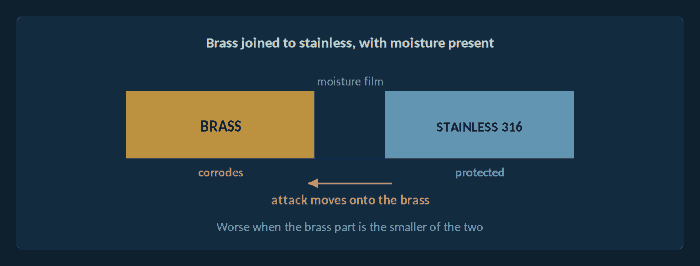
With an electrolyte bridging them, brass is the anode and corrodes preferentially while the stainless is protected. Keep the brass part the larger of the two.
Whether this matters depends on conditions. In dry compressed air or in oil there is no electrolyte and no cell, and mixed assemblies run for years. In a wet or coastal environment it matters a great deal, and it is made worse by area ratio: a small brass part joined to a large stainless one concentrates the attack on the brass.
If you must mix, keep the brass component the larger of the two where you can, isolate the joint from moisture, or use a dielectric union.
One refinement worth knowing: this polarity holds while the stainless stays passive. Inside an oxygen-starved crevice the stainless can go active, at which point it sits below brass in the galvanic series and the direction of attack reverses. Crevices in wet service deserve attention for this reason alone.
Cost, lead time and machinability
Brass is significantly cheaper per piece than 316, and the difference is not only raw material. Brass machines faster, wears tooling less, and can be hot-stamped, so the labour content per part is lower and volume production is quicker. For high-volume, low-pressure, benign-media applications, brass is not a compromise — it is the engineering answer as well as the commercial one.
316 costs several times more and takes longer to produce. Spend it where the corrosion, temperature, pressure or certification requirement justifies it.
A note for importers and distributors
Two things are worth settling before an order rather than after:
Lead content in potable-water parts. Several markets restrict lead in wetted plumbing components — the United States, for example, limits lead to a 0.25% weighted average across wetted surfaces under federal drinking-water rules, and the European Union operates positive lists of acceptable materials in contact with drinking water. Standard leaded brass will not satisfy these. If your customers install into potable systems, confirm the alloy and the applicable approval before you commit.
Material certification. For stainless in process or instrumentation service, buyers frequently require a mill test certificate traceable to the heat. Ask for it at the enquiry stage. A certificate confirms composition and mechanical properties for the batch; it is not a statement about corrosion performance in your particular medium, which remains a design decision.
Choosing from our range
Brass — Brass Compression Fittings, Brass Tube Fittings, Brass Flare Fittings, Brass Valves and Cock Fittings. Typical parts include the Brass Connector Elbow Male and Brass Branch Tee Male.
Stainless steel — Stainless Steel Tube Fittings, Stainless Steel Pipe Fittings, Stainless Steel Weld Fittings, Stainless Steel Valves. Typical parts include the Male Connector Fractional Tube × NPT (M) — SS 316 and Male Connector Metric Tube × ISO Tapered (M) — SS 316.
If the thread on your existing equipment is the open question rather than the material, see our guide to identifying NPT, BSPT and BSPP threads.
Vikay Fittings is a worldwide supplier of brass and stainless steel fittings from India. Tell us the medium, the pressure, the temperature and the market you are supplying, and we will confirm the material with you before you order — send an enquiry.

Comments