
NPT vs BSPT vs BSPP: How to Identify the Thread You Already Have
Two threads can look identical, screw together for two or three turns, and still be the wrong pair. That is the everyday problem with NPT and BSPT. They share the same 1:16 taper, they overlap on thread count in several sizes, and their diameters differ by fractions of a millimetre. A fitter forces the joint, the flanks bear on the wrong angle, and the connection either weeps under pressure or strips the softer of the two parts.
This guide shows how to identify a thread you are holding, using a vernier caliper and a thread pitch gauge, and how to specify the right one when you order.
The three threads, briefly
NPT — American National Pipe Taper. Governed by ASME B1.20.1. The thread form has a 60° included angle with flattened crests and roots, and the thread tapers at 1:16, which works out to ¾ inch of diameter change per foot of length. Because the crests and roots are flat, there is a spiral leak path along the thread even when it is fully made up, so an NPT joint depends on PTFE tape or a liquid sealant. NPTF, the "dryseal" variant, uses a controlled crest-to-root interference to close that path without sealant — but only in a new, NPTF-to-NPTF joint. Reused NPTF fittings, and any NPTF thread mated with a standard NPT one, still want sealant.
BSPT — British Standard Pipe Taper, designated R for male and Rc for female. Governed by ISO 7-1. The thread form is Whitworth: a 55° included angle with rounded crests and roots. The taper is also 1:16. Like NPT, it seals on the thread flanks and normally wants a sealant. Watch for a third designation here: ISO 7-1 also defines Rp, a parallel internal thread that legitimately mates with a tapered R male. Plenty of ports sold loosely as "BSPT female" are in fact Rp, so it is worth confirming which one your equipment has before ordering Rc.
BSPP — British Standard Pipe Parallel, designated G. Governed by ISO 228-1. Same 55° Whitworth form, same thread counts as BSPT in each size, but the thread does not taper at all. A BSPP thread is not a sealing thread. It carries load only. The seal is made somewhere else — a bonded seal washer under the hex, an O-ring in a machined groove, or a 60° cone seat inside the port. Wrapping PTFE tape onto a BSPP male and tightening it is the single most common cause of a leaking parallel joint.
You will also see metric parallel threads (M12×1.5, M14×1.5, M16×1.5) on European instrumentation. These have a 60° angle and a pitch specified in millimetres rather than threads per inch, and like BSPP they seal on an O-ring or cone, not on the thread.
How to identify a thread in four steps
Step 1 — Decide whether it is tapered or parallel
Look along the thread from the side against a straight edge. On a tapered thread the crests visibly climb; on a parallel thread they run flat. If it is not obvious, put a caliper across the crests at the first full thread near the end, then again four or five threads back. A tapered thread will grow by roughly 0.3 mm in the smallest sizes and up to 0.7 mm at 1 inch. A parallel thread will not change. Note that at 1/8" the growth is close to the repeatability of a hand caliper, so lean on the visual check in the small sizes.
This single check separates BSPP from everything else, and it is the check people skip.
Step 2 — Measure the diameter
For a male thread, measure the outside diameter across the crests, and match it against the chart below.
For a female thread, measure the bore across the thread crests — this is the minor diameter. Be careful here: it runs roughly 2 to 4 mm smaller than the matching male OD, not marginally smaller, so it cannot be read against the male chart. A 1/2" NPT female bore measures about 17.8 mm, which sits right between the 3/8" BSP and 3/8" NPT male figures and will lead you to call a 1/2" port a 3/8" one. Identify female threads primarily by thread count and by whether the thread tapers.
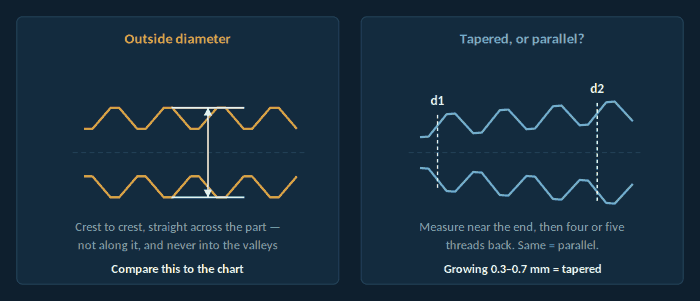
Measure a male thread across the crests and a female thread across the bore. The male outside diameter always reads a few millimetres larger than the female bore of the same nominal size.
One caution that matters on tapered threads: the major diameter changes along the length, so the figures in the charts below are the nominal major diameter at the gauge plane, not at the very end of the part. Measure a few threads back from the small end and treat the reading as approximate — you are using it to choose between two candidates, not to certify the part.
Step 3 — Count the threads per inch
A thread pitch gauge is the fast way: try leaves until one seats into the crests with no rocking and no daylight. Without a gauge, lay a steel rule along the thread, align the zero mark with the tip of one crest, and count the crests that fall within one inch.
Step 4 — Match against the chart
Nominal size | NPT — TPI | NPT — male OD (in) | NPT — male OD (mm) | BSP — TPI | BSP — male OD (in) | BSP — male OD (mm) |
1/8" | 27 | 0.405 | 10.29 | 28 | 0.383 | 9.73 |
1/4" | 18 | 0.540 | 13.72 | 19 | 0.518 | 13.16 |
3/8" | 18 | 0.675 | 17.15 | 19 | 0.656 | 16.66 |
1/2" | 14 | 0.840 | 21.34 | 14 | 0.825 | 20.96 |
3/4" | 14 | 1.050 | 26.67 | 14 | 1.041 | 26.44 |
1" | 11½ | 1.315 | 33.40 | 11 | 1.309 | 33.25 |
The BSP column applies to both BSPT and BSPP — they share thread counts and diameters within a size, and differ only in whether the thread tapers.
Note also that the nominal size is not a measurement of anything. A 1/2" NPT male is 21.34 mm across the thread, not 12.7 mm. The fraction refers to the approximate bore of the pipe the thread was originally designed for.
The sizes where people get caught
1/2" and 3/4". In these two sizes NPT and BSP have the same thread count — 14 TPI — so a pitch gauge tells you nothing. The diameters differ by 0.015 inch at 1/2" and 0.009 inch at 3/4", which is 0.38 mm and 0.23 mm. At that margin, a worn caliper or a burred crest will mislead you.
In these sizes, identify by thread form instead. Hold the part under good light with a loupe. A 60° NPT thread has visibly flat crests, like a series of small plateaus. A 55° BSP thread is rounded over, with no flat at all. Once you have seen the two side by side the difference is unmistakable, and it is the only check that does not depend on a fraction of a millimetre.

At 1/2 in and 3/4 in the thread count is identical. The crest form is the only reliable difference: NPT is flat and 60 degrees, BSP is rounded and 55 degrees.
1/8". Here the counts differ by one — 27 against 28 — which is a single crest across an inch. Use the diameter as the deciding measurement, since 10.29 mm against 9.73 mm is a comfortable gap.
1". NPT drops to 11½ TPI while BSP is 11. Again a difference of half a crest per inch, and again the diameters are close, 33.40 mm against 33.25 mm. Fall back on thread form.
Sealing: three threads, three different rules
NPT seals on the flanks under interference, but the flat crests and roots leave a helical gap. Apply PTFE tape in the direction of thread rotation, two to three wraps, starting one thread back from the end so tape does not shear off into the line. Anaerobic pipe sealant is preferable on instrument lines, where shredded tape in a gauge or a needle valve is a real failure mode.
BSPT seals the same way and takes the same treatment.
BSPP does not seal on the thread at all. Use a bonded seal washer — a steel ring with a vulcanised elastomer inner lip — under the hex against a flat spotface, or an O-ring where the port is machined for one. If you tighten a BSPP male into a BSPP female with tape and no washer, you have a mechanically sound joint that leaks.
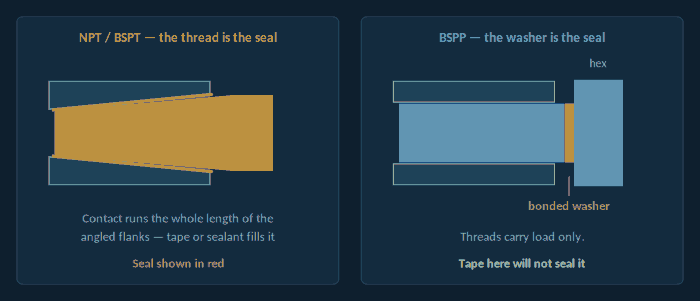
NPT and BSPT seal on the thread flanks under interference. BSPP does not seal on the thread at all - the seal is made on the face, by a bonded washer or an O-ring.
Never mix. An NPT male will start into a BSPT female and take a couple of turns before binding, which is exactly why the mistake survives assembly and shows up under pressure. The 5° difference in included thread angle means the two forms bear on a line contact rather than a face, and the joint has no meaningful pressure rating.
Specifying threads when you order
On our product pages the thread is named in the description of every part:
NPT (M) or NPT (F) — American taper, ASME B1.20.1
ISO Tapered (M) — BSPT, ISO 7-1, the thread you may know as R
ISO Parallel (M) — BSPP, ISO 228-1, the thread you may know as G, requiring a separate seal
O-seal ISO Parallel or O-seal NPT — a parallel or taper thread with an O-ring groove machined into the fitting, sealing on the face rather than the thread
SAE-MS Straight — SAE J514 straight thread O-ring boss; the mating port is specified by SAE J1926 / ISO 11926
So, for example, Male Connector Fractional Tube × NPT (M) — SS 316 and Male Connector Fractional Tube × ISO Tapered (M) — SS 316 are the same fitting body with two different port threads. Choosing between them is entirely a question of what is already machined into your equipment.
When you send an enquiry, three pieces of information remove all ambiguity:
Thread standard and size — "1/2 NPT male", not "1/2 inch male"
Tube size and system — 12 mm OD metric tube, or 1/2 inch fractional tube
Material — brass, SS 304 or SS 316
If you have the part in hand but not its designation, measure the diameter, count the threads, note whether it tapers, and send those three numbers. That is enough for us to identify it.
Where to go next
Stainless Steel Tube Fittings — SS 316 compression tube fittings in NPT, ISO tapered, ISO parallel, O-seal and SAE-MS port threads
Brass Compression Fittings — brass olive fittings for metric and imperial tube
Stainless Steel Pipe Fittings — threaded pipe fittings in NPT and BSP
Brass or stainless steel 316? How to choose the right fitting material
Vikay Fittings is a worldwide supplier of brass and stainless steel fittings from India. If you need help matching a thread on existing equipment, send us an enquiry with your measurements and we will identify it for you.

Comments